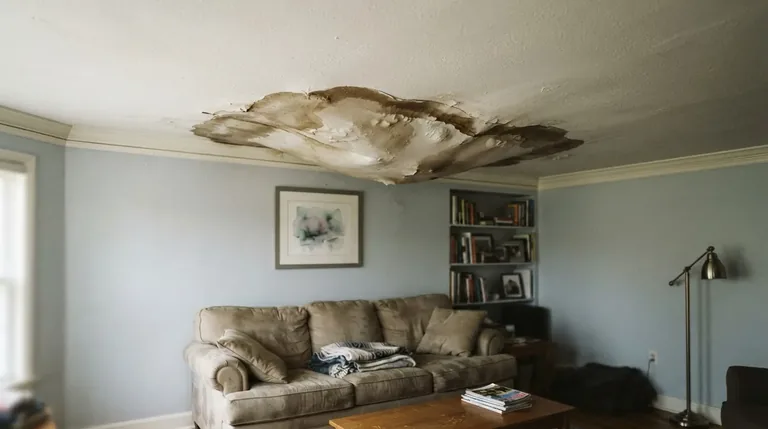
Ceiling Water Damage in Fort Worth, TX: What to Check First
A stained or sagging ceiling can come from a roof leak, an upstairs pipe, or a frozen attic line. Here is what to check first, and when a permit question goes to Development Services.
Who to Call First in Fort WorthWhere Ceiling Water Damage Comes From in Fort Worth
A stained or sagging ceiling in a Fort Worth home has possible sources including roof leaks, plumbing leaks, and HVAC condensate: a roof or hail-damaged section above, a plumbing line running through the floor or wall above the ceiling, or — during a hard freeze — a line inside an unheated attic. Where the stain appears is not a reliable guide to where the water got in, so have the source assessed.
- Roof and hail storms: damaged shingles, flashing, or a cracked vent boot can let rain in during a storm.
- Plumbing above the ceiling: a bathroom, kitchen, or laundry line on the floor above can leak into the ceiling cavity.
- Frozen attic lines: during a hard freeze, a supply line running through an unconditioned attic can split and leak once it thaws; see frozen and burst pipes for what to do about the pipe itself, not just the ceiling.
- A clogged HVAC condensate line from an attic air handler can overflow onto the ceiling below.
What the City Says About Local Storms
The City of Fort Worth says heavy rainfall from localized thunderstorms is the primary cause of flooding here, and that these storms can occur year-round, not just in one season. The National Weather Service Fort Worth office also tracks freeze risk for the area: its climate data show an average first freeze date of November 22 and an average last freeze date of March 12.
A stain does not always sit directly under the leak. Have the source assessed rather than treating the stain's location as a diagnosis.
If you suspect a pipe beneath the foundation, contact a plumber to investigate. See slab leak water damage for what to do next.
Safety Checks Before You Start
Before you inspect a wet or sagging ceiling, check for two hazards: structural weakness and electricity. A ceiling section heavy with trapped water can sag or fail without warning, and water that reaches a light fixture, fan, or outlet is a shock risk. Stay away from suspected structural or electrical hazards and seek qualified assistance.
- A sagging, bulging, or cracked ceiling section can hold a large amount of water and may fail suddenly. Stay out from under it and keep children and pets away.
- If water is dripping near a light fixture, ceiling fan, or outlet, treat that circuit as unsafe. FEMA says not to touch wet electrical equipment or electrical equipment while standing in water. If the panel or area is wet, wait for qualified assistance.
- If you can reach your home's main water shut-off valve safely, use it to stop the source. Do not force a valve you cannot operate; seek qualified help.
- For a Fort Worth water or sewer emergency — including sewage reaching the ground outside — call the city's water emergency line, 817-392-4477, Option 1.
When to Stay Out Entirely
If the ceiling is visibly bulging, you hear cracking, or a section has already come down, do not go back into the room to inspect or clean up. Wait for a restoration provider or a qualified contractor who can judge whether the structure is safe to enter.
Documenting the Damage for Your Insurer
Before you move or discard anything beyond what safety requires, photograph the ceiling, the edges of the stain, and any belongings the water damaged. Write down the date you noticed the problem and, if you know it, when the leak likely started. This record helps your insurer evaluate the claim and helps you if you need a second opinion later.
- Photograph the ceiling from several angles, including close-ups of sagging, cracking, or discoloration.
- Photograph and keep damaged items — furniture, flooring, electronics — until your insurer has had a chance to review them, unless they present a health or safety hazard.
- Note the date you first noticed the stain and any recent storm, hail, or freezing weather that may explain it.
- Contact your insurer promptly to open a claim, and ask what documentation they want before you make repairs beyond what is needed to prevent further damage.
| Situation | Who to contact | Number | Checked |
|---|---|---|---|
| Water or sewer emergency, including sewage reaching the ground | Fort Worth Water | 817-392-4477, Option 1 | September 2026 |
| Repair or reconstruction permit question | Development Services | 817-392-2222 | September 2026 |
| Insurance claim question or complaint | Texas Department of Insurance | 800-252-3439 | September 2026 |
For a complete overview of handling water damage in Fort Worth, see the Fort Worth water damage overview.
Sudden Damage vs. Gradual Damage Under Your Policy
Texas homeowners insurers generally treat a ceiling leak differently depending on how it started. According to TDI, sudden and accidental water discharge is usually covered, subject to your policy's terms. Water that seeped in slowly over weeks or months is often treated differently, and your policy wording controls the outcome.
What TDI Says About Coverage
The Texas Department of Insurance says a sudden and accidental release of water is generally covered under most standard homeowners policies, while continuous leakage or seepage is generally excluded. Flood damage is generally excluded under most standard homeowners policies. Ask your insurer how the actual source of the water affects coverage.
- Sudden and accidental discharge: most standard policies generally cover this, subject to your deductible and policy terms.
- Continuous leakage or seepage over time: most standard policies generally exclude this.
- Flood water from outside the home: generally excluded; separate flood insurance is a different policy.
- Mold that grows after a covered water loss: TDI says mold is generally excluded except for repair work tied to a covered loss; your policy wording controls.
Repair cost depends on the extent of the damage, the materials involved, and whether mold remediation is needed. Compare the provider's itemized estimate with the insurer's estimate and ask about differences; for a broader look at how restoration costs are typically evaluated here, see Fort Worth restoration cost.
If you rent your home, tell your landlord about the ceiling leak in writing. Your renters policy generally covers your personal belongings, not the ceiling or the building itself.
This page explains general information about how Texas policies typically treat water damage. It is not legal or insurance advice; ask your insurer or agent how your specific policy applies.
Permits for Ceiling Repairs
Whether a ceiling repair needs a permit in Fort Worth depends on the scope of the work. Ask Fort Worth Development Services at 817-392-2222 whether your specific repair requires a permit. When in doubt, ask before you start.
- Cosmetic drywall repair and painting: ask Development Services whether a permit applies.
- Electrical work near the ceiling: ask Development Services whether an electrical permit applies.
- Structural repair, such as replacing damaged framing: ask Development Services whether a building permit applies.
- The City of Fort Worth's Development Services Department, at 817-392-2222, can tell you which permits apply to your project.
Development Services is located at City Hall, 100 Fort Worth Trail, Fort Worth, TX 76102. Call before you start work if you are not sure whether a permit applies.
Mold Risk After a Ceiling Leak
Wet drywall and insulation inside a ceiling cavity can support mold growth faster than many homeowners expect. FEMA and the EPA each describe it in their own words below.
What FEMA and EPA Say
FEMA's Ready.gov program states: "Wet carpeting, furniture, bedding and any other items holding moisture can develop mold within 24 to 48 hours."
The EPA states: "In most cases, mold will not grow if wet or damp items are dried within 24-48 hours."
- A ceiling cavity holds insulation and hidden framing. Ask the provider how it will assess moisture in affected materials.
- Materials that stayed wet for an extended period before you found the leak are more likely to need this kind of check.
- A musty smell after the visible repair is finished is a reason to ask the provider to check further, not something to cover with paint.
Texas generally requires licenses for mold assessment and remediation. The under-25-contiguous-square-foot exemption applies to remediation, and a separate exemption covers owners working on their own residential property with fewer than 10 dwelling units. For the licensing thresholds, the certificate requirement, and what to ask a provider, see mold after water damage.
If That Did Not Work
If you called the city's water emergency line and could not get through, or the problem turned out to be inside your home rather than in the city's system, you have other options.
- Try the water emergency line again — 817-392-4477, Option 1 — the number the city publishes for water and sewer emergencies.
- If the leak is inside your home rather than in the city's water or sewer system, contact a plumber — ask for proof of any trade license the work requires — or a local restoration provider directly. For a Fort Worth water emergency, call 817-392-4477, Option 1. A plumber or restoration provider can discuss work inside your home.
- If you are unsure whether the damage is covered by insurance, contact your insurer directly, or call the Texas Department of Insurance at 800-252-3439 with a coverage question or complaint.
For flood zone information and who to call first for a range of water emergencies in Fort Worth, see who to call first in Fort Worth.
Frequently Asked Questions
What is the first thing to do about a ceiling leak in Fort Worth?
Does a stain directly under the leak show exactly where the water came in?
Can I throw away a wet, sagging piece of drywall right away?
Can my policy cap what it pays for mold after a ceiling leak?
Who do I call if my repair attempt does not fix the problem?
Where is Fort Worth's Development Services Department located?
Water in your home right now?
See who to call first in Fort Worth, how to reach your water provider, and how to check your flood zone.
Who to Call First in Fort Worth