Water Damage Restoration Cost in Fort Worth, TX
The national figures below are not Fort Worth-specific prices. III/ISO, 2019–2023: $15,400 average claim severity; 1.50 claims per 100 insured house-years.
Who to Call First in Fort WorthWhat Moves a Fort Worth Estimate
Several factors separate one water damage estimate from another: the category of water involved, how much area it reached, which materials got wet, and how long they stayed wet before work started. A small, clean-water leak caught quickly costs less to fix than sewage or floodwater that sat for days.
- Water category — clean supply water, used "gray" water, or contaminated sewage or floodwater
- Affected area — a single room versus multiple rooms or floors
- Materials involved — carpet and drywall dry and rebuild differently than hardwood floors or built-in cabinetry
- Time wet — ask the provider which materials need drying, removal, or replacement due to how long they stayed wet
Ask the provider for an itemized estimate describing the scope and charges, which helps explain why a slab leak or a frozen or burst pipe that goes unnoticed for days tends to cost more than the same problem caught quickly.
What National Price Guides Report
The national figures below are not Fort Worth-specific prices. The ranges below come from national consumer cost guides, not government data, and are not a quote for your job — ask the provider assessing your damage for a written estimate.
- According to Angi (2026), water damage restoration nationally runs $450 to $16,000, averaging $3,868, or roughly $3 to $7.50 per square foot depending on water category
- According to HomeAdvisor (2025/2026), typical jobs run $1,383 to $6,369, averaging $3,868, with ceiling water damage repair around $450 to $1,600 and plumbing repair around $1,000 to $4,000
These are national consumer survey figures, not a price specific to Fort Worth or Tarrant County. Treat them as a planning range, not a ceiling or a floor for what any specific job should cost.
Official Loss Figures and NFIP Coverage Limits
Two official sources put numbers on water damage losses, separate from any contractor's marketing figures: insurance industry claims data, and FEMA's estimate of flood damage by inch of water. Neither is a price you would pay a restoration provider — they measure loss and coverage, not labor cost.
| Fact | Figure or Detail | Source |
|---|---|---|
| Average water damage and freezing insurance claim (national) | $15,400 average claim severity; 1.50 claims per 100 insured house-years (2019–2023) | III/ISO |
| FEMA flood damage estimate, 1,000 sq. ft. one-story home | About $11,000 for the first inch of floodwater inside the home | FEMA |
| NFIP building coverage limit, 1-4 unit homes | Up to $250,000 building, $100,000 contents | FEMA/NFIP |
| NFIP waiting period | Coverage typically takes effect 30 days after purchase | FEMA/NFIP |
| Insurance claim complaint line | Texas Department of Insurance, 800-252-3439 | TDI |
Checked: September 2026.
NFIP flood insurance is separate from a standard homeowners policy and has its own limits and waiting period, per FloodSmart. The Fort Worth flood zones and water shutoff guide covers who to call first and how to check your address's flood risk.
How Your Deductible and the Adjuster's Estimate Interact
Your policy's deductible is the amount you pay before your coverage starts, and it is set in your policy, not by the restoration provider. Ask your insurer how your policy terms, deductible, and the documented damage affect payment.
- The adjuster inspects the damage and writes a scope of work, similar to what the restoration provider documents
- If the estimates differ, ask the provider and insurer to explain the different items
- A sudden and accidental water discharge is usually covered under most standard policies; continuous leakage or seepage is usually excluded, according to the Texas Department of Insurance
This page is general information, not insurance advice. Check your policy's declarations page for the deductible.
How to Read a Restoration Estimate
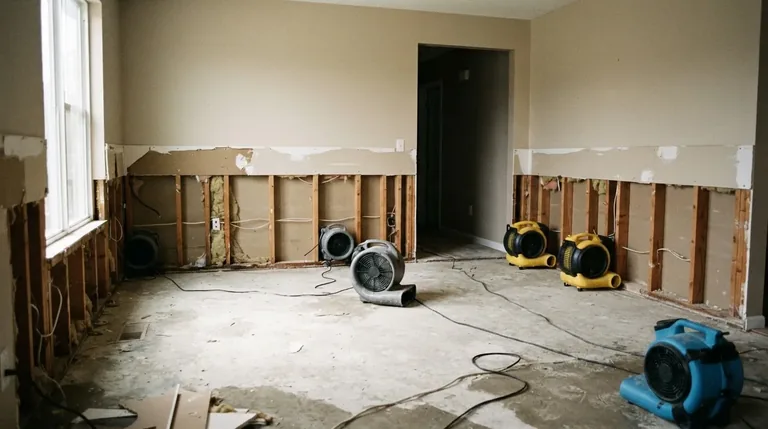
A written estimate should break the job down by task, not give a single lump sum. Ask the provider to separate water extraction and drying, demolition of damaged materials, and rebuilding, so you can compare it against what the insurance adjuster approved.
- Extraction and drying — removing standing water and running equipment to dry the structure
- Demolition — identify any materials the provider proposes to remove and the reason
- Rebuild — replacing what was removed
- Any mold-related work, called out separately from drying and rebuild
Ask for the estimate in writing before work begins, and ask what a change in scope would look like once the provider opens up a wall or floor. A written, itemized estimate is easier to compare against a second opinion or an adjuster's number than a single total.
The 15% Reduction in Flood Insurance Premiums in Fort Worth
Because Fort Worth participates in the National Flood Insurance Program and the Community Rating System, the city says residents can get flood insurance with premiums 15% lower than they would be without that participation, according to a September 2025 city letter to floodplain property owners.
- NFIP and CRS participation — premiums 15% lower, per the City of Fort Worth
- Personalized flood-risk consultations for properties in or near flood-prone areas, at no charge, per the city
- Coverage typically takes effect 30 days after purchase, with some exceptions
- Contact: Stormwater Management, 817-392-6261, floodplain@fortworthtexas.gov
This reduction applies to NFIP flood insurance, which is separate from the water damage coverage in a standard homeowners policy. Ask your insurance agent whether your policy already reflects this 15% premium reduction before assuming it does.
If That Did Not Work
If a provider's estimate does not match what your insurer approved, or you cannot get a written estimate at all, you have other options. None of these is promised to be faster than the last one.
- Ask a different local restoration provider for a second written estimate
- If the gap is with your insurer's adjuster, ask the insurer to review the estimate or request a re-inspection
- If you believe your insurer is handling the claim unfairly, contact the Texas Department of Insurance at 800-252-3439
Each of these routes addresses a different mismatch — between two providers, between the provider and the adjuster, or with the insurer itself — so start with the one that matches what went wrong. See the Fort Worth water damage guide homepage for an overview of what to do after any type of water damage.
Frequently Asked Questions
Is there a typical price for water cleanup in Fort Worth?
What is included in a typical restoration estimate?
Does my deductible determine what I pay out of pocket?
What is the NFIP premium reduction in Fort Worth?
Why do two restoration estimates for the same damage differ?
Is there a calculator to estimate my cost?
Water in your home right now?
See who to call first in Fort Worth, how to reach your water provider, and how to check your flood zone.
Who to Call First in Fort Worth