Slab Leak Water Damage in Fort Worth, TX: What to Do First
Texas A&M AgriLife Extension says North Texas soil is heavy clay. If you suspect a leak under your Fort Worth slab, a plumber can investigate the line.
Who to Call First in Fort WorthSigns of a Slab Leak You Can Observe
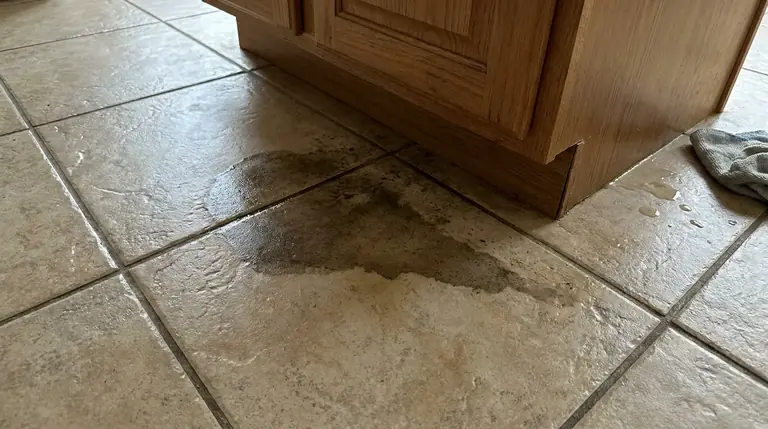
A slab leak is a leak in a water line running under your home's concrete foundation. Possible observations include a higher water bill with no new use, a warm or damp spot on the floor, a persistent sound of running water, or unexplained moisture along a baseboard — these do not establish the source.
- A water bill that jumps with no obvious new use
- A warm patch on the floor, even in rooms without a heater
- Damp carpet, buckling flooring, or a musty smell in one area
- The sound of running water when every fixture in the house is off
- Mold or discoloration along a baseboard or wall near the floor
- Water pressure at a fixture that has dropped for no clear reason
None of these signs confirms a slab leak on its own, and none of them tells you how bad it is. A water line under a slab is not something you can inspect yourself. If you suspect a plumbing leak, contact a plumber, since what water damage restoration typically costs tends to depend on how long water sits before it is addressed.
Who Fixes What: City Pipes vs. Your Private Line
Fort Worth's published dividing line covers sewer pipes: the city is responsible for sewer collectors and outfalls located within public rights-of-way and easements, and the homeowner is responsible for the private line that runs from those mains to the house, according to the city's sewer FAQ.
That split applies to sewer lines specifically. Contact Fort Worth Water about responsibility for the specific water-supply line under your slab. If sewage is surfacing on the ground rather than water pooling from a supply line, the city says to call 817-392-4477 to report it.
| What | Who Handles It |
|---|---|
| Sewer collectors and outfalls in rights-of-way and easements | City of Fort Worth |
| Private sewer line from the main to the house | Homeowner |
| Sewage surfacing on the ground | Report to 817-392-4477 |
| Building or repair permit questions | Development Services, 817-392-2222 |
| A dispute with your insurer over a claim | Texas Department of Insurance, 800-252-3439 |
Checked: September 2026.
Restoration Provider or Plumber: Who to Call First
A plumber finds and repairs the leaking line. A restoration provider dries out and repairs what the leak has already damaged — flooring, drywall, cabinets. A plumber can address the leaking line; a restoration provider can assess damage to affected materials.
- If water is actively escaping, avoid electrical hazards and contact a plumber or the appropriate utility
- A plumber can investigate the suspected leak
- Ask who will investigate and repair the plumbing, and ask for proof of any trade license the work requires; a restoration provider can separately address any mold that follows unnoticed water damage
- A plumber does not typically dry out or repair flooring, drywall, or cabinets damaged by the water
If you are not sure where to start, the Fort Worth water shutoff and flood-zone guide walks through who to call first for a water emergency at your address.
What Your Insurance Company Typically Looks At
Texas insurers generally treat a slab leak differently depending on how it happened. A sudden and accidental discharge of water is usually covered under most standard policies, while continuous or repeated seepage — water that has been leaking slowly for a long time — is usually excluded, according to the Texas Department of Insurance. Unlike a frozen or burst pipe, a slab leak's slow onset can blur that line for an adjuster.
This page provides general information, not legal or insurance advice. Your policy's exact wording controls what is and is not covered.
- Whether the cause looks sudden and accidental, or continuous seepage over time
- Photos and a written plumbing report describing the leak
- The scope of drying and repair needed, reflected in the adjuster's estimate
Because the distinction between sudden and gradual often decides the claim, ask your insurer what documentation it needs to evaluate the cause and damage. If your insurer denies a slab leak claim, you can also file a complaint with the Texas Department of Insurance at 800-252-3439.
Permits and Working Near the Right-of-Way
A slab leak repair that touches plumbing systems, breaks up flooring, or requires work near the public right-of-way may need a permit. Development Services handles permit questions for the City of Fort Worth at 817-392-2222.
Ask the permit office directly whether your specific repair needs a permit before work starts. The answer depends on the scope of the job, not just the fact that a pipe under the slab needs fixing.
- Development Services, City of Fort Worth: 817-392-2222
- City Hall address: 100 Fort Worth Trail, Fort Worth, TX 76102
- Ask specifically whether your repair scope requires a permit before work starts
If That Did Not Work
If your first call to a plumber or a restoration provider does not resolve the problem, or you cannot reach anyone, you have other options. None of these routes is promised to be faster than the last one.
- Call a different plumber or restoration provider that serves your ZIP code
- Contact Development Services at 817-392-2222 if the issue involves a permit or a question about the right-of-way
- If the disagreement is with your insurer rather than the repair itself, contact the Texas Department of Insurance at 800-252-3439
Each of these contacts covers a different part of the problem — the repair itself, city permitting, or a dispute with your insurer — so start with the one that matches what went wrong. See the Fort Worth water damage guide homepage for an overview of what to do after any type of water damage.
Frequently Asked Questions
What does a slab leak look like from inside the house?
What should I ask a plumber before a slab leak repair?
Should I call a plumber or a restoration provider first?
Can clay soil actually cause a slab leak?
What if I am not sure it is a slab leak at all?
If a builder's work caused my slab leak, what should I do?
Water in your home right now?
See who to call first in Fort Worth, how to reach your water provider, and how to check your flood zone.
Who to Call First in Fort Worth